
Hardware
--
Questions
--
Followers
Top Experts

I'm working on an ECG applcation, getting the signal from the heart, and processing it. The circuit I'm building is an analogue circuit, it has a single supply of +5 V and ground. Please see the picture to know the topology I'm trying to do
 . I need you to help me find the most suitable multiplexer upon the following requirements.
Mandatory requirements:
1 - The multiplexer to take in 4 input analogue signals and output 1 analogue signal. (It's fine if the multiplexer is dual or even quad 4:1 multiplexer with common select signals, I would only use 1 circuit per IC).
2 - The multiplexer to have very low input noise (because it will take the signal from the heart and the signal is very small and sensitive, 2mV amplitude and 1 - 100 Hz frequency)
3 - The multiplexer to operate on single supply of +5V (or less) and ground (i.e. no -ve voltage supply to be needed).
4 - The multiplexer to be in DIP or PDIP package.
5 - The multiplexer select inputs will be input from a microcontroller.
Optional requirements (preferable)
1 - To have a SPICE simulation model
2 - To be cheaper than £10 (UK sterling pounds) because my project has a limited budget.
I usually order components from any of these websites, in uk.farnell.com, uk.rs-online.com, and http://www.digikey.co.uk/
Please be very elaborate in your answers and help me reach a specific answer.
Zero AI Policy
We believe in human intelligence. Our moderation policy strictly prohibits the use of LLM content in our Q&A threads.


I were only saying average specifications, the high pass filter is at 0.1 Hz, and the low pass filter is at 150 Hz. Please help me with the multiplexer
@DaveBaldwin
I tried to search for "input leakage" but couldn't understand it, can you briefly explain what is input leakage in a multiplexer and how it affects my circuits ?
You mentioned "which I believe is higher than the input current for the amplifier", first, I'm not gonna use that same exact amplifier in the picture, I might be using AD620, or INA122 or INA125 or others (I'm searching for a single-supply instrumentation amplifier, you can help me here https://www.experts-exchange.com/questions/27465862/How-to-make-my-circuit-work-on-batteries.html#37333425). Anyway, so "Leakage limits for the NXP 74HC4052 are up to +/-1uA which I believe is higher than the input current for the amplifier" what does that mean or indicate ?
Thank you guys for your help. keep it up :D
Ok so I understood what you meant by leakage current. I didn't understand "If the 'off-state' leakage for the mux inputs is 1uA, then you could have 3uA from the 3 inputs that are off feeding into the 'on' input." what 'on' input are you referring to ?
To make it brief, so what do you suggest ? Do you reckon I should simply put the multiplexer AFTER the instrumentation amplifier ? The signal quality is the most important priority so I don't want anything to affect the measurement. Or should I simply look for a multiplexer with very low input leakage current
I have 4 electrodes connected to the body, (1 of them is gonna be connnected to ground). I want to have the ability to input any combination of signals to the AD620 instrumentation amplifier. i.e. I have electrodes A,B,C and D. I want to input to the AD620 signals A - B, B - A, A - C, C - A, and so on.
why will I have a problem creating a ground ? my ground is gonna be 0 V, and everything will be connected normally, the components I use will be chosen so that they operate on single supply. Please explain.


EARN REWARDS FOR ASKING, ANSWERING, AND MORE.
Earn free swag for participating on the platform.

WOW, that was a great answer. I'm trying to read and understand but first I think you should have a look at my circuit.

What's the main advantage gained when connecting the electrodes to a buffer amp ? I don't prefer to input the heart signal directly into the IA, because I need to see many pairs of signals, hence I'm gonna have to build many IA's in my circuit.
You mentioned "you could reference each IA to the "ground" electrode and subtract them in a downstream IA fed by the output of two muxes" , so why and how do I reference each IA to the ground electrode ? why can't I just connect the electrode to the input of the multiplexer ?
so you reckon I should stick with douple supply ? I could use the LT1054 to get a regulated -5 V
@gismo51
Thank you so much for your help guys, I really appreciate it, you made me rethink some design decisions. Man I got myself into so much trouble haha
1 - OK, I will only use 3 inputs (the 4th will be ground). I would use 3 AD620's. Here's the topology I'm gonna build, any comments on that ?
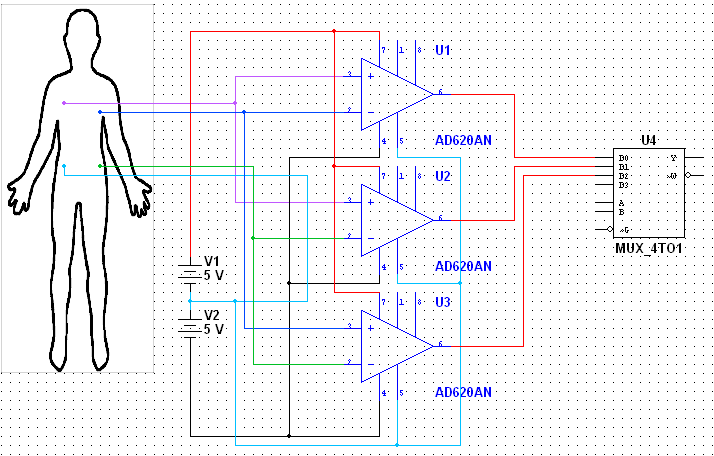
OK, I'm gonna use the LT1054 to get me -5 V. Seems I totally misunderstood when d-glitch told me to use a single positive power supply (https://www.experts-exchange.com/questions/27465862/How-to-make-my-circuit-work-on-batteries.html#37200659), I don't think he meant use single supply for the op-amps, rather he might have meant generate the negative supply from the positive supply.
2 - Now that I've changed the topology as you can see in the picture, and decided to use dual +5 and -5 supply, what 4:1 or 8:1 multiplexer would be most suitable ? I've checked the MAX328 it's really good, but now that I've changed the topology, is it still the most suitable ?
3 - quick question, what's the difference between single input multiplexers and differential input multiplexers ?
Thank you so much for the explanations. Please answer these last questions stating a specific multiplexer and I'll end the question.
gismo51, thanks so much, you really helped me a lot, I will add the resistors you mentioned . The sensor leads will be totally isolated don't worry.
I finally found what I need. Thanks a lot
Get a FREE t-shirt when you ask your first question.
We believe in human intelligence. Our moderation policy strictly prohibits the use of LLM content in our Q&A threads.
Hardware
--
Questions
--
Followers
Top Experts
Hardware includes cell phones and other digital living devices, tablets, computers, servers, peripherals and components, printers and scanners, gaming consoles, networking hardware such as routers, hubs, switches and modems, storage devices and security equipment such as firewalls and other appliances.