
VMware
--
Questions
--
Followers
Top Experts

In the settings below:
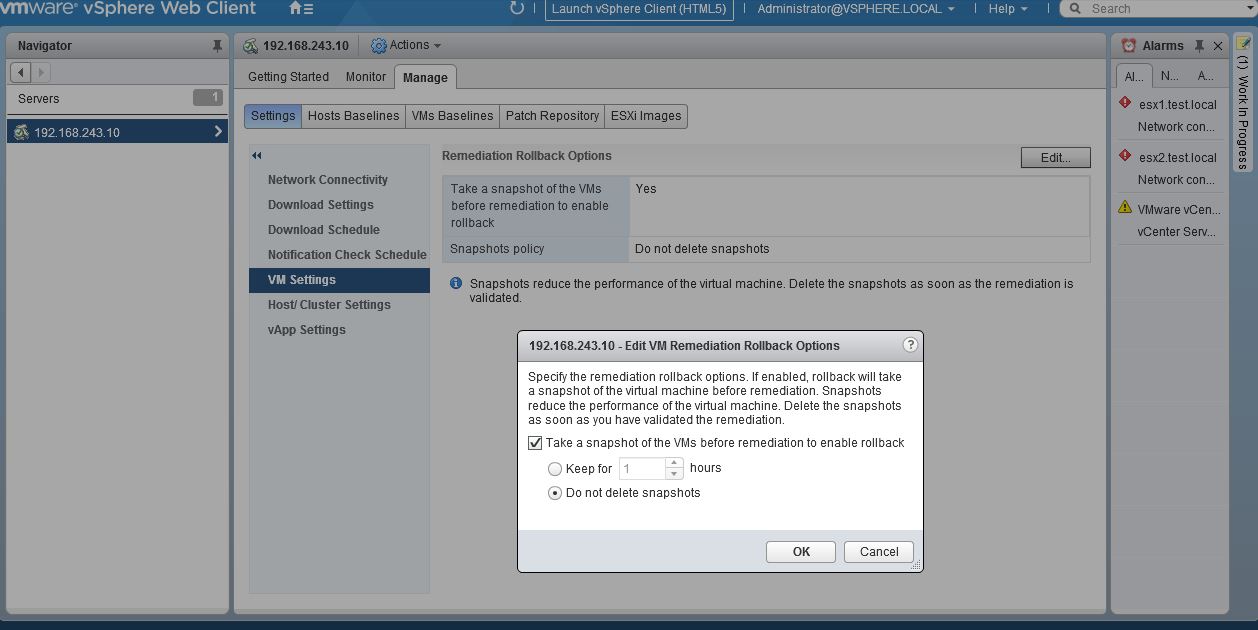
By default it is set to "Do not delete the Snapshot".
So after updating the VM, the snapshot will stay there until we delete it manually.
if I set it to "keep for : 1 hour"
then if the update takes longer than one hour , the snapshot will probably be deleted before even the update has completed the install. in some instance updates install can be slow
What is the best practice for those settings ?
Thank you
Zero AI Policy
We believe in human intelligence. Our moderation policy strictly prohibits the use of LLM content in our Q&A threads.

if you proceed to the update during the night, I would say 24 h long is a good time to find an issue after an update.


EARN REWARDS FOR ASKING, ANSWERING, AND MORE.
Earn free swag for participating on the platform.
VMware
--
Questions
--
Followers
Top Experts
VMware, a software company founded in 1998, was one of the first commercially successful companies to offer x86 virtualization. The storage company EMC purchased VMware in 1994. Dell Technologies acquired EMC in 2016. VMware’s parent company is now Dell Technologies. VMware has many software products that run on desktops, Microsoft Windows, Linux, and macOS, which allows the virtualizing of the x86 architecture. Its enterprise software hypervisor for servers, VMware vSphere Hypervisor (ESXi), is a bare-metal hypervisor that runs directly on the server hardware and does not require an additional underlying operating system.